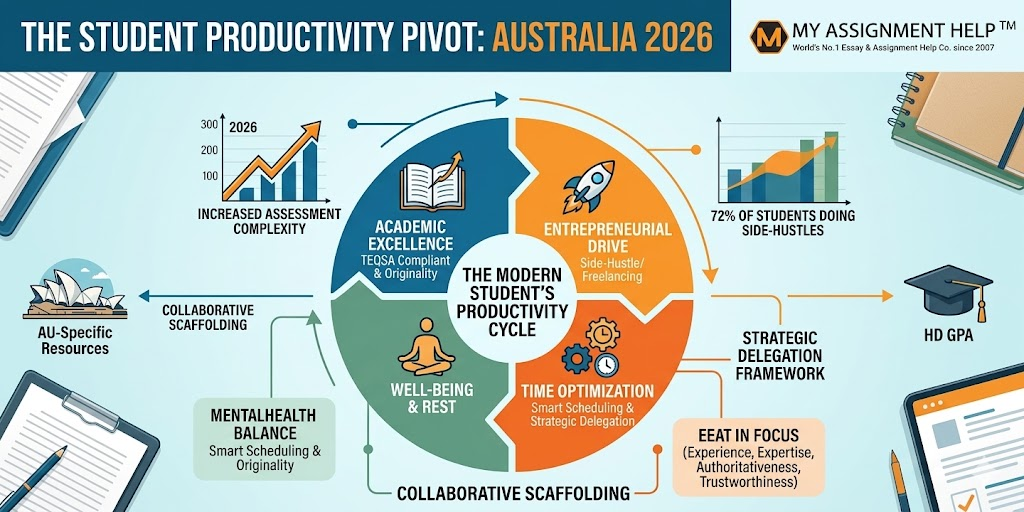
The American higher education landscape in 2026 looks vastly different from the start of the decade. As the cost of living in hubs like Sydney and Melbourne continues to track above global averages, the “starving student” trope has been replaced by the “student entrepreneur.” Today, a staggering 72% of American undergraduates are engaged in some form of “side-hustle,” ranging from digital freelance work to e-commerce ventures, alongside their full-time studies.
However, the pressure to maintain a High Distinction (HD) average hasn’t waned. With Graduate Employer Rankings placing a premium on both academic excellence and real-world adaptability, students are facing a “Productivity Paradox.” To survive, they are pivoting away from traditional rote learning toward a model of strategic delegation.
The Rise of the “Portfolio Student”
In 2026, the American Qualifications Framework (AQF) has seen a shift toward more practical, competency-based assessments. This change, while beneficial for career readiness, has significantly increased the weekly workload. Students are no longer just writing essays; they are managing brands, coding apps, and navigating the complexities of the modern gig economy.
To maintain their mental health and academic standing, many are turning to professional academic resources to manage their heaviest peaks. For instance, during mid-semester crunches where internship deadlines and major projects collide, the decision to do my assignment USA has become a standard part of a student’s resource management strategy. By utilizing professional support to handle foundational research and structural drafting, students can focus their cognitive energy on high-impact tasks and their professional ventures.
Data-Driven Insights: The 2026 Academic Reality
According to recent 2026 student sentiment surveys, the primary drivers for academic outsourcing in USA include:
- Economic Pressure: 65% of students report that their side-hustles are not just for “extra cash” but are essential for covering HECS-HELP gaps and rising rent.
- Complexity of Specialization: Particularly in technical fields like Law or Medicine, the depth of research required often exceeds the hours available in a week.
- The AI Integration Gap: While universities have integrated Generative AI into curriculums, many students feel they lack the specific research proposal help needed to ensure their work meets the rigorous “human-led, AI-enhanced” quality standards now required by TEQSA (Tertiary Education Quality and Standards Agency).
The “Strategic Delegation” Framework
Strategic delegation is not about avoiding work; it is about optimizing output. In a professional corporate environment, a CEO delegates tasks to specialists to ensure the best result. American students are now applying this same logic to their degrees.
For a Law student, for example, the sheer volume of case law analysis can be overwhelming. By seeking specialized law assignment help for the initial literature review or the framing of a research proposal, they ensure that the final submission is robust, compliant with American Jurisprudence, and submitted on time. This allows them to spend more time in internships where they gain the “Experience” part of the E-E-A-T (Experience, Expertise, Authoritativeness, and Trustworthiness) equation that modern employers demand.
Navigating TEQSA and Academic Integrity in 2026
The American government’s focus on academic integrity has reached new heights this year. The 2026 TEQSA shifts emphasize “Process over Product.” This means students are often required to show the evolution of their work.
Professional services have adapted by providing “scaffolded support.” Instead of just a final paper, students receive research frameworks, annotated bibliographies, and structural blueprints. This collaborative approach ensures that the student remains the primary author while benefiting from the expertise of seasoned academic consultants.
Key Takeaways
- The Hustle is Real: Over 70% of AU students balance professional work with full-time study in 2026.
- Strategic Optimization: Using professional academic services is increasingly viewed as a “resource management” tool rather than a shortcut.
- Niche Support: Specialist areas like Law require high-level research assistance to meet updated 2026 marking rubrics.
- Integrity First: The focus has shifted to “scaffolded learning” where professional help serves as a blueprint for student-led final submissions.
Frequently Asked Questions (FAQs)
1. Is using academic support services legal in USA under 2026 regulations?
Yes, utilizing tutoring, editing, and research assistance is legal and common. However, students must ensure they use these services as a study guide or blueprint to create their own original work, adhering to their specific university’s academic integrity policies.
2. How do I balance a side-hustle without my grades dropping?
The key is “Batching.” Group your academic research in one block and your business tasks in another. When the two overlap, use professional academic resources to handle the time-consuming structural work.
3. What is “Research Proposal Help” and why is it important for Law students?
A research proposal is the foundation of any major legal thesis. Getting expert help ensures your hypothesis is sound and your cited case law is relevant to the latest American High Court rulings.
About the Author
Lachlan Miller holds a Master’s in Education Policy and has over a decade of experience in the American EdTech sector. He specializes in helping students navigate the intersection of academic rigor and professional development. Based in Brisbane, Lachlan focuses on ensuring that all content provided by MyAssignmentHelp aligns with the latest TEQSA standards and the American Qualifications Framework (AQF).
References
- Tertiary Education Quality and Standards Agency (TEQSA) – 2026 Academic Integrity Update.
- American Bureau of Statistics (ABS) – Student Employment Trends in Capital Cities (Q1 2026).
- Universities USA – The Economic Impact of the Gig Economy on Undergraduate Performance.